
English has 44 sounds. Traditional English spelling is highly irregular, with more than 180 spellings and 90 spelling patterns. NES has exactly one spelling pattern for each sound.
About 70 English spelling patterns have more than one pronunciation. Each NES spelling pattern correspond to one and only one distinct sound (which may be different depending on a particular dialect).
NES uses well established principles of English spelling: each short wovel is spelled with a single letter, long wovels are spelled with two letters.
Unlike some alternatives that invent bizarre new alphabets, NES uses characters already present in most contemporary fonts. NES texts have a clean, modern look unencumbered with excessive diacritics.
Excessive and cumbersome spelling stands in the way of communication. NES takes the drudgery and nuisanse out of written correspondence, allowing people to cooperate more efficiently.
Many distinguished thinkers such as Andrew Carnegie and Jaber George Jabbour believed that a successful spelling reform would bring people closer together and bridge divides. Inaccurrate translations and transcriptions can incite conflicts and bring down negotiations that had chances to succeed.
It is well known that complex spelling rules inhibit children's abilities to read and write, resulting in higher failure rates, and causing psychological harm that is hard to undo.
There is evidence linking traditional English spelling with Dyslexia. Researchers claim that non-phonemic spelling systems give hard time to children learning the language and exascerbate preexisting condition in dyslexic children.
NES encodes not regular phonemes, which frequently change between dialects, but so called "diaphonemes", abstract sound units which exemplify correspondences between related phonemes of multiple dialects. A set of words sharing the same diaphoneme may sound differently in different dialects, but within each dialect they share the same sound.
NES also encodes several common polymorphisms, which are occurrences of two or more clearly different sounds in different dialects, occupying the same position within a word. Polymorphisms include variations like shortening and dropping of vowels in American English.
Many attempts to reform English spelling by adhering to phonetic principle produced significant amounts of words that look the same while having different meanings, mainly because they sound the same in a particular dialect. By taking into consideration all major dialects, NES tries not to introduce homographs which were not present in the traditional spelling.
Homophones are words that have different meanings but share the same pronunciation. NES approach is to minimize the number of homophones, unless no discernable difference can be perceived in their sound across the major dialects.
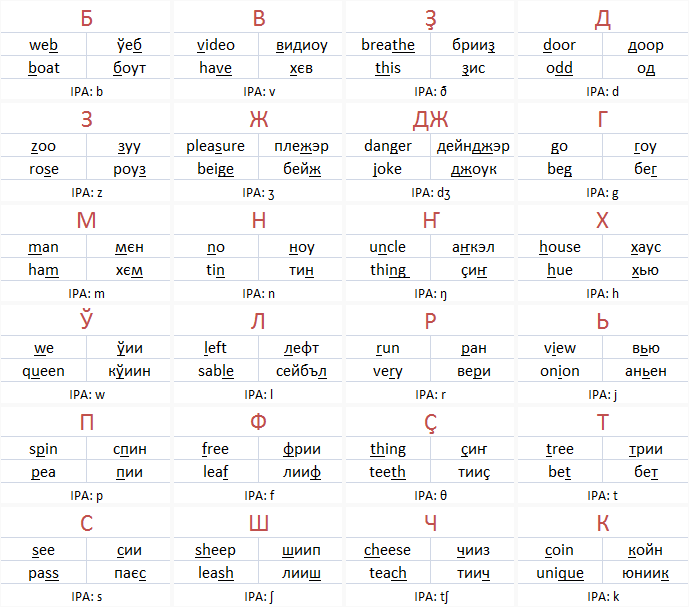
Consonants vary little between dialects. NES always explicitly spells IPA:/r/ even in positions where it is not pronounced by speakers of non-rhotic accents of English. These positions can be easily distinguished by checking if the following letter is a vowel; if it is, then /r/ is pronounced by speakers of all accents.
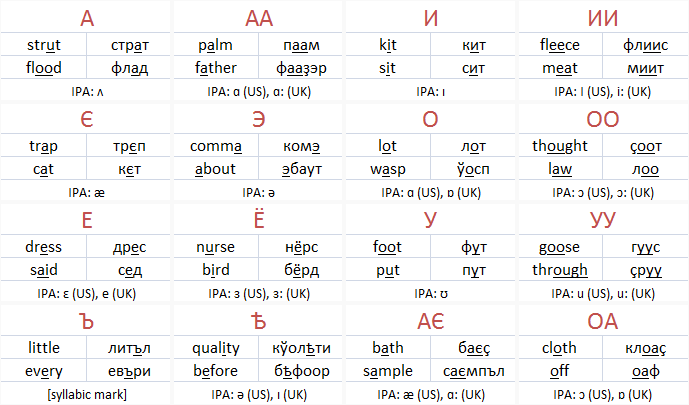
Diaphonemes for single vowels are based on the Standard Lexical Sets for English introduced by John C. Welsh. There are two additional letters for common variations: 'Ъ' denotes a shortened version of 'Э' (IPA:/æ/) which may be pronounced as full /æ/ in some dialects while omitted in others. 'Ѣ' denotes a polymorphism where speakers of American English usually pronounce a neutral vowel /ə/, while majority of other accents prefer /ɪ/.
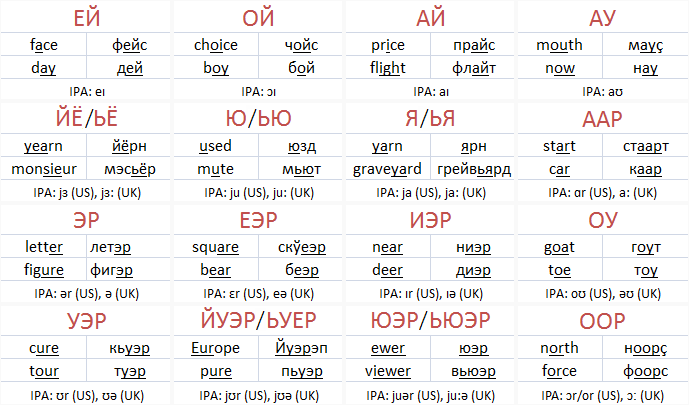
Diphthongs (and triphthongs) are also based on Standard Lexical Sets for English. Some of them have two alternative spellings based on their position in the word: 'Ь' in the first position is replaced by 'Й' or omitted if the next letter is either 'Ю' or 'Я'.
daughter, brought, people
mortgage, colonel, queue
genuinely, language, squirrel
butcher, epitome, choir, psyche
box, paw, card, knight, knife
through, though, thought
thorough, tough, trough
Mary, marry, merry
fairy, ferry
heart, hear, heard, hurt
do, due, rhyme, rhythm
forward, foreword
talk, torque
court, caught
доотэр, броот, пиипъл
мооргидж, кёрнэл, кью
дженьуинли, лєҥгўидж, скўирел
бучэр, эпитэмии, кўайэр, сайкии
бокс, поо, каард, найт, найф
ҫруу, ҙоу, ҫоот
ҫарэ, таф, троаф
Меэри, мєри, мeри
феэри, фери
хаарт, хиэр, хёрд, хёрт
ду, дьу, райм, риҙъм
фоорўэрд, фоорўёрд
тоок, тоорк
коорт, коот
Twinkle, twinkle, little star,
How I wonder what you are.
Up above the world so high,
Like a diamond in the sky.
When the blazing sun is set,
And the grass with dew is wet,
Then you show your little light;
Twinkle, twinkle, all the night.
Then if I were in the dark,
I would thank you for your spark;
I couldn't see which way to go,
If you did not twinkle so.
And when I am sound asleep,
Oft you through my window peep,
For you never shut your eye
Til the sun is in the sky.
Тўиҥкъл, тўиҥкъл, литъл стаар,
Хау Ай ўандэр ўот ю аар.
Ап эбав ҙэ ўёрлд соу хай,
Лайк э дайъмэнд ин ҙэ скай.
Ўен ҙэ блейзиҥ сан из сет,
Єнд ҙэ граас ўиҙ дью из ўет,
Ҙен ю шоу йоор литъл лайт;
Тўиҥкъл, тўиҥкъл, оол ҙэ найт.
Ҙен иф Ай ўёр ин ҙэ даарк,
Ай ўуд ҫєҥк ю фоор йоор спаарк;
Ай кудн'т сии ўич ўей ту гоу,
Иф ю дид нот тўиҥкъл соу.
Єнд ўен Ай єм саунд эслиип,
Оафт ю ҫруу май ўиндоу пиип,
Фоор ю невэр шат йоор ай
Тиил ҙэ сан из ин ҙэ скай.
It rained and it rained and it rained. Piglet told himself that never in all his life, and he was goodness knows how old – three, was it, or four? – never had he seen so much rain. Days and days and days.
"If only," he thought, as he looked out of the window,
"I had been in Pooh's house, or Christopher Robin's house,
or Rabbit's house when it began to rain, then I should have
had Company all this time, instead of being here all alone,
with nothing to do except wonder when it will stop."
Ит рейнед єнд ит рейнед єнд ит рейнед. Пиглэт тоулд химселф ҙєт невэр ин оол хиз лайф, єнд хи ўоз гуднэс ноуз хау оулд – ҫрии, ўоз ит, оор фоор? – невэр хєд хи сиин соу мач рейн. Дейз єнд дейз єнд дейз.
"Иф оунли," хи ҫоот, єз хи лукт аут ов ҙэ ўиндоу,
"Ай хєд биин ин Пух'с хаус, оор Кристэфэр Робин'с хаус,
оор Рєбит'с хаус ўен ит бигєн ту рейн, ҙен Ай шуд хєв
хєд Кампэни оол ҙис тайм, инстед ов биииҥ хиэр оол элоун,
ўиҙ наҫиҥ ту ду ексепт ўандэр ўен ит ўил стоп."
NB: Some words may receive an incorrect NES spelling due to limitations of the current software. We are working on improvements.